
A note about dates and historical labels
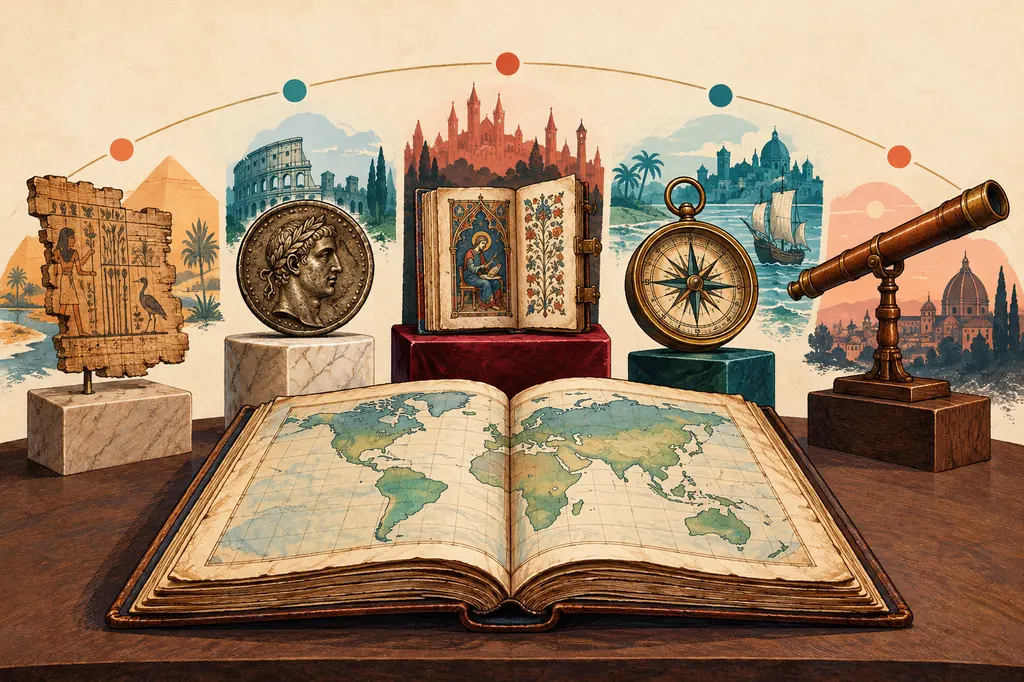
History is not a single timeline that every region shares. Terms such as ancient, medieval, and modern are convenient ways to group questions, but historians use different boundaries for different places. The headings here help readers browse; they are not claims that every society changed eras at the same moment.
Some short answers also simplify a complicated story. The notes add context where a familiar fact needs a qualifier, such as the long development of the Great Wall or the different printing histories of Europe and East Asia. For a class assignment or publication, follow the sources and course conventions your teacher or editor specifies.
Browse the history trivia questions
Ancient History Trivia Questions
Start with societies around the Nile, the Mediterranean, and the Andes. These questions focus on recognizable people and places while leaving room for the different ways historians describe the ancient world.
1 of 30 questions: Which river's annual floods helped sustain ancient Egyptian agriculture?
Answer: The Nile
Why it matters: Annual flooding left fertile soil along the Nile, supporting farming and settlement in ancient Egypt.
2 of 30 questions: Who became Rome's first emperor under the title Augustus?
Answer: Augustus
Why it matters: Octavian adopted Augustus in 27 BCE, a date often used to mark the Roman Empire's start.
3 of 30 questions: Which Greek city-state was known for a military-centered society?
Answer: Sparta
Why it matters: Sparta emphasized military training for male citizens; ancient Greek city-states had varied societies.
4 of 30 questions: Which script appears on many monumental ancient Egyptian inscriptions?
Answer: Egyptian hieroglyphs
Why it matters: Scribes also used hieratic and demotic; hieroglyphs were one part of Egypt's writing culture.
5 of 30 questions: Which philosopher tutored Alexander of Macedon?
Answer: Aristotle
Why it matters: Aristotle taught Alexander in youth, linking Greek philosophy with Macedonian royal history.
6 of 30 questions: Which people built Machu Picchu in the Andes?
Answer: The Inca
Why it matters: UNESCO identifies Machu Picchu as an Inca urban creation, not a Europe-centered milestone.
Medieval History Questions and Answers
This section ranges from England and Byzantium to West Africa and Japan. Medieval is a useful label in many history courses, but it does not describe one shared period across the world.
7 of 30 questions: In which year did the Norman Conquest of England begin?
Answer: 1066
Why it matters: William's 1066 invasion and victory at Hastings changed England's rulers, landholding, and language.
8 of 30 questions: What charter did King John seal in 1215?
Answer: Magna Carta
Why it matters: Barons forced the charter from King John; later debates made it a symbol of limits on royal power.
9 of 30 questions: What was the capital of the Byzantine Empire?
Answer: Constantinople
Why it matters: Today it is Istanbul; Byzantine names the Eastern Roman state centered there after western Rome changed.
10 of 30 questions: Which West African ruler is remembered for a famous pilgrimage to Mecca?
Answer: Mansa Musa
Why it matters: Mansa Musa ruled Mali in the fourteenth century; his pilgrimage reflected West African trade and power.
11 of 30 questions: Which empire captured Constantinople in 1453?
Answer: The Ottoman Empire
Why it matters: Mehmed II led the conquest; 1453 is a common European marker, though period boundaries differ.
12 of 30 questions: What name is used for the Japanese warrior class that served local lords?
Answer: Samurai
Why it matters: Samurai roles changed over centuries, so the name does not imply one fixed code or duty.
History Trivia About Trade, Art, and Ideas
People, goods, and knowledge moved across long distances. These questions connect Italian cities, Asian empires, ocean voyages, and the routes that carried ideas between regions.
13 of 30 questions: Which Italian city became a major center of the Renaissance?
Answer: Florence
Why it matters: Florence funded artists and scholars; the Renaissance also flourished in many other cities.
14 of 30 questions: Who is associated with movable-type printing in fifteenth-century Europe?
Answer: Johannes Gutenberg
Why it matters: Gutenberg's press spread books in Europe; East Asia had earlier movable-type printing traditions.
15 of 30 questions: Which Mughal emperor commissioned the Taj Mahal?
Answer: Shah Jahan
Why it matters: Shah Jahan commissioned the marble mausoleum in Agra for Mumtaz Mahal within a larger complex.
16 of 30 questions: Which dynasty built many of the best-known surviving sections of China's Great Wall?
Answer: The Ming dynasty
Why it matters: The Ming built many surviving northern sections; the Great Wall spans structures from several periods.
17 of 30 questions: What name is given to the network of routes that linked China with Central Asia and the Mediterranean?
Answer: The Silk Roads
Why it matters: The Silk Roads were overlapping land and sea routes carrying goods, people, technologies, and ideas.
18 of 30 questions: Which expedition completed the first circumnavigation of Earth?
Answer: The Magellan-Elcano expedition
Why it matters: Magellan died in 1521; Elcano and the surviving crew completed the voyage in 1522.
Trivia Questions About Revolutions and Independence
Revolutions often unfold over years rather than in a single moment. The questions below point to milestones in France, the Americas, Japan, India, and South Africa.
19 of 30 questions: In what year did the French Revolution reach its first major climax?
Answer: 1789
Why it matters: Britannica dates the broader movement from 1787 to 1799, with 1789 as its first climax.
20 of 30 questions: Which document announced the thirteen American colonies' declaration of independence in 1776?
Answer: The Declaration of Independence
Why it matters: The Archives transcription is dated July 4, 1776, when the colonies declared their case for separation.
21 of 30 questions: Which Caribbean country declared independence in 1804 after a successful revolution?
Answer: Haiti
Why it matters: Haiti's revolution, led by enslaved people and free people of color, created the first independent Black republic.
22 of 30 questions: What 1868 change in Japan restored imperial rule and ended the Tokugawa shogunate?
Answer: The Meiji Restoration
Why it matters: The Meiji Restoration began rapid political, economic, educational, and social changes in Japan.
23 of 30 questions: In which year did India gain independence from Britain?
Answer: 1947
Why it matters: India became independent in August 1947, during the partition of British India.
24 of 30 questions: Who became president after South Africa's first multiracial election in 1994?
Answer: Nelson Mandela
Why it matters: Mandela became president after apartheid-era minority rule ended; many leaders and communities shaped the struggle.
Modern World History Trivia Questions
Finish with science, international institutions, civil rights, spaceflight, and a major change in Europe. The dates are memorable, but each answer also points to a wider story.
25 of 30 questions: Which scientist became the first woman to receive a Nobel Prize in 1903?
Answer: Marie Curie
Why it matters: Curie shared the 1903 Physics prize with Pierre Curie and Henri Becquerel for research on radiation.
26 of 30 questions: In which year did World War II end?
Answer: 1945
Why it matters: Germany surrendered in May and Japan in September, so the war ended at different times in Europe and Asia.
27 of 30 questions: What international organization was founded in 1945 to support peace and cooperation?
Answer: The United Nations
Why it matters: The UN Charter took effect in October 1945, creating a forum for postwar international cooperation.
28 of 30 questions: Which 1954 U.S. Supreme Court case rejected racial segregation in public schools?
Answer: Brown v. Board of Education
Why it matters: The Supreme Court rejected school segregation in 1954; desegregation faced resistance and took years.
29 of 30 questions: Which mission first carried astronauts to a crewed landing on the Moon in 1969?
Answer: Apollo 11
Why it matters: Armstrong and Aldrin landed while Collins orbited; Armstrong became the first person to walk on the Moon.
30 of 30 questions: In which year did the Berlin Wall open and begin to fall?
Answer: 1989
Why it matters: East German crossings opened in November 1989; removal of the wall continued afterward.
How to use these history trivia questions
The list works for a solo warm-up, a classroom review, or a casual history round. Decide whether the group is playing for points or simply collecting interesting facts before you begin.
- Read the prompt firstGive yourself or the group a moment to recall the answer. For a hosted round, read only the question and keep the answer line covered.
- Reveal and award a pointUse one point for each correct answer, or give a bonus point when a player can explain the context. Agree on spelling and alternate names before scoring.
- Keep the explanationRead the short note after the answer. It adds a date, region, or qualification that makes the fact easier to remember and less likely to be repeated out of context.
Sources for selected history facts
These references support several dated or place-specific answers. The explanations remain short, so use the linked source when you need fuller historical context.
- UNESCO World Heritage Centre: Historic Sanctuary of Machu PicchuUNESCO's description of the Inca urban site and its setting.
- NASA: Apollo 11Mission purpose, crew, and Neil Armstrong's first step on the Moon.
- U.S. National Archives: Declaration of Independence transcriptionThe archival transcription dated July 4, 1776.
- Nobel Prize: The 1903 Nobel Prize in PhysicsThe award record for Marie Curie, Pierre Curie, and Henri Becquerel.
- Encyclopaedia Britannica: French RevolutionA reference timeline that places the revolution across 1787 to 1799, with a first climax in 1789.
History Trivia Questions FAQ
Quick answers about question count, difficulty, dates, and ways to use the list.
How many history trivia questions are included?
There are 30 questions with answers and short explanations. They are grouped into five broad sections so a host can choose a smaller round or work through the full set.
Are the history trivia questions easy or hard?
The set mixes familiar dates and people with questions that reward a little more context. It is intended for general knowledge, not a graded history test.
Can I use these history questions for a quiz night?
Yes. Read the prompt aloud, give teams time to answer, and reveal the answer and explanation after each question. Set scoring rules before the round if alternate names may count.
Is this page an interactive history quiz?
This page is a readable question-and-answer guide. For a live quiz experience, use the site's homepage category area to choose a history round from the available trivia topics.
Want a live trivia round too?
Use the answers here for a read-aloud game, or visit the main trivia page to choose a live round and explore other categories.
Browse trivia categories